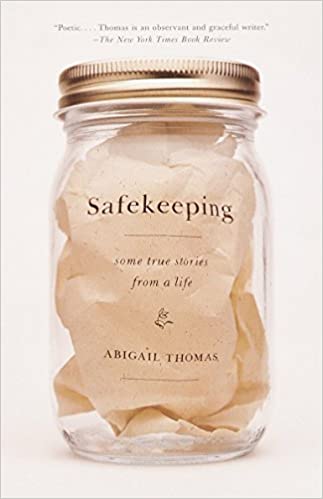
As you can see from the picture above, the book cover has a Mason jar stuffed with paper. I think this is an excellent image for the content, as this promises to provide the little vignettes from the author’s life in neat little containers. Some chapters are tiny in this creative non-fiction account, but they are tightly packed with emotional firecrackers.
Thomas’s memoir takes us on a journey through her adult life: three marriages, random job and unemployment, physical and mental health discoveries, raising children in impoverished environment, and how she is changed through living these experiences.
Although at the time of the writing, she is married to her third husband, the underlying thread throughout is the enduring and often turbulent, relationship with her second husband. Their relationship is unconventional, yet not entirely uncommon, but seeing her struggles within as it relates to who she is will have your considering the ramifications of your own past and past decisions.
Her writing is a down-to-earth mixture of simple language, couched in vibrant image and poetry. This book will keep you reaching for more as you make your way to the end of this little boo, and thinking about her well beyond those 179 pages.
There are just those moments. You know, those moments when your brain tells you the correct way to act, but it also tells compels you to do something you know is completely wrong. As an adult, for the most part, we have these compulsions under control, but a child, that’s another story.
That’s the story I want to talk about. It’s “the look.”
Every child has a parental “look” that stops them dead in their tracks, or at least makes them rethink their next move.
In my childhood home (and probably my child’s childhood home), it was the sideways glance.
Although I was usually fairly, well-behaved, and as an only child, accustomed to being the little sprout in the room, knew how to control and conduct myself, but sometimes I had this mischievous imp that took over my soul, controlling my actions, and the word quit didn’t quite make it to the recesses of my cerebrum. The moments, like when my mom couldn’t say a word correctly and I would bring it up ad nauseum, or my dad would be trying to work on a musical interlude, and I wouldn’t stop plucking a guitar string or plunking a piano key. Like crack to my brain, I couldn’t get enough – giggle, giggle, ha, ha, ha, and all was fine and dandy until I got the sideways glance – The Look…
You know, the one where the face turns toward you, but not the full face, just a kinda hint at the fire that is burning below. Usually there’s not even a frown, because a frown you can further your instigation, but a grim teeth-gritting glance that says, “Just one more, I dare you,” and you know you’d better end the antics.
I, the one who pushed it too far, would then proceed to feel mortally wounded, as if this rejection were a sign of their lack of love, as if I were the innocent one. I, no longer loved by those who have professed to love me through anything, would retreat, in defeat, to my room or a friend’s house or my grandmother’s house (to tell her how mean they are), and vow that they would never hurt me again.
Meaningful Life. Isn’t this what everyone wants; to have a purpose beyond the trivialities and challenges of every day life?
My pastor told us we have to ask ourselves three things for our lives to have meaning:
Where did I come from?
Why am I here?
Where am I going?
These three questions make sense to me. When I think about who I am, it always involves where I came from. Theologically, this would mean that I came from God. Which is something I believe, but it’s also about my origins in this world. I came from my parents, and all that they have contributed to who I am. I came from a geographic area, and all the influences that are attached to that place. My friends, my family, and my experiences have all made me who I am, and are a significant part of who I am today. Without this background information, my life is shallow and doesn’t fully have meaning. I think about the undeveloped character in a story, and how the reader cannot relate to a character unless they have been introduced to some of the character’s backstory, and usually the more robust this knowledge, the better the reader can follow the character’s thinking.
This backstory is constantly being updated and added to. I am here because of the choices that I made; each layer adding a new path to the one that led me here. This is why I am here, but I’m also here because God has deemed that I be here. I was born with a purpose. Yes, I’m still wondering what that purpose is, but maybe it, too, isn’t just one purpose. Maybe like the backstory has brought me here, there were multiple purposes in each of those decisions and paths that have led me this purpose, which will lead me to my next purpose.
And that is the million-dollar question that constantly permeates the sponge-matter in my brain. Where am I going? What’s next? I live far too much in the future. I know this about me, and I am trying to be more present in each moment; even in the mundane things, like washing dishing and doing laundry. I am trying to pay attention to the feel and smell of the soap as I sop the glasses, and feeling the texture of the materials of the clothes as I fold them. This for me is living in the moment.
Life on earth here is about the moments, the decisions, the times of the past and times of the future, but these pale in comparison to where we came from, why we’re here, and where we are going in the times stretched before our birth and death dates. We have come from a loving God, to show God that we love him and want to be back with him. If we do that, we will be going back to from whence we came. This temporal life is confusing, stressful, challenging, scary, bittersweet, and wonderful, but choosing to go home is what the final road is and I believe the purpose for living. Thank you God for your love.
I’m taking a Folklore and Film class, so I imagine the next few month’s movie reviews will have to do with movies that involve some level of folk story. It should be interesting and fun.
Tonight, I watched the 1995 film, The Secret of Roan Inish, directed by John Sayles. I spent one hundred minutes immersed in the salty Irish sea air, listening to the lilting Irish brogue, in a tragic fantasy.
This film centers on a young girl named Fiona Caneely and her family. The weather on the remote Irish islands is unpredictable and dangerous, has caused the death of her mother, the loss of her baby brother, and had forced her and the extended family members to abandon their home on tiny Roan Inish (which means “Island of the seals”). This has caused familial separation from what was once a tribe-like existence to Fiona, father and brother, and her uncle and his family moving to the mainland, while her grandparents moved to another remote island near Roan Inish. Fiona’s father is not handling the loss of his wife and son very well, and in a typified Irish male response to trouble, has become a resident of the local pub, so Fiona is sent to stay with her grandparents on their remote island near Roan Inish. Once she arrives, she is told fantastical tales of the past, and in heroistic fashion, she sets about getting things right.
This is a mythical tale, focused on the Caneely clan, that involves a boy at sea, a mythological creature, and the strength and determination of a young girl. There are many symbols associated with Irish culture, like pubs and beer, tea, the sea, storytelling, Catholicism, and a musical soundtrack that cannot help but to draw you into an Irish state of mind.
In addition to the Irish setting and Irish family, there are many seagulls and seals who are as much a part of the story (or maybe more) than the people. The seals first greet Fiona as she arrives to the island, and the seagull is never far from her. The mythical tale involves a seal-woman, called a selkie (not a selfie!), who is taken by a Caneely man two generations before, and since the Irish are superstitious, believe that “the sea gives and it takes away.” So, the chain of events is the man takes the selkie, and the sea takes their homes and their child. Ultimately, all’s well that ends well.
Given the prevalence of the seal and seagull, I thought it prudent to look up what they symbolize. The seagull is called “the muse of bird kingdom” on nativesymbols.info, and dreamingandsleeping.com say they symbolize freedom and carefreeness, that they are the “sailors of the world,” and they are hearty and calm. The seal is said to symbolize innocence. When I put these two together, the tale uses a lot of imagery for the mermaid. The selkie is said to be “seal folk, seals are said to have been mistaken for mermaids by sailors of the world, and mermaids are often portrayed as innocent (though not always). This is what gives the story mystery.
I think this movie is an interesting tale. It is authentic in an Irish yarn-spinning way, and the Irish islands are authentically portrayed in their remoteness and extreme harshness. The cultural and familial stereotypes in this film effectively immerses the watcher into the director’s designed world to the extent that the watcher believes the tales that are being told. I would recommend watching it if you feel like escaping from the mundanity of the everyday.
Flaws. One puts their flaws at the wrong end of the telescope, projecting them onto other planets (or persons). Tiny pinpoints that twinkle and reflect, at once noticeable, yet indistinct, until someone points out the Big Bear you thought was only a little bear.
Standing on the sidelines, pondering the scene and thinking about how we are judged and how we judge others.
It’s the prom – 1989. The music plays, Thompson Twins spewing forth that we need someone to hold me now, and the situation itself lends to this sentiment.
Instead, I’m holding a cup of (terrible) punch, watching others have a good time.
I wonder why I came.
But I know why.
I’m driven by hope; the hope of being noticed and verified – by him. I watch and wait, expectant.
Karen, my friend, is out there mingling as she does so well. Dancing with everyone, all the boys AND girls. They all love her.
She looks over at me, gesturing that I should come join her. I slowly shake my head, content to wallow in my misery. She pulls a face at me and continues in her reverie.
I just want Anthony to notice me. He is the only reason that I agreed to put myself through this torture. My introverted bones scream to be released from this hell. My mind fights the urge to leave.
My favorite teacher, Mr Jones, sees me in my solitude, decides to rescue me from myself, and asks me if I care to dance. No, no thank you. I’m fine.
Undaunted, he starts to talk about what is happening in front of our eyes. He points out the scenery: Joan’s beautiful blue dress; layers of taffeta sweeping the ground, swirling as she turns in the arms of her date, whose shimmering blue shirt perfectly complements her cascading finery. He points to a couple who are whispering in each other’s ears. They erupt into laughter as we watch.
I begin to feel even more isolated. I try to excuse myself so I can be alone with my pain and loneliness. He refuses to be dismissed.
“Would you care to dance?”
I beg off, yet again, but stick by his side.
I see, off in the shadows, a girl, solo; looking at her feet, unaware of what is happening around her. I wonder what is like to be her.
I am seized by a gripping thought – I AM HER…
She is so focused on her flaws that she cannot see beyond her microscopic reality.
Me.
Through my telescope, which I’ve turned around so I can see clearer, I look.
I ask Mr. Jones to go ask the lonely girl to dance, and with surprised face, he acquiesces. I watch him approach her, see her face alight with joy as they hit the dance floor.
Feeling a sense of good, right, I drop my reserve, walk to the dance floor and cut in on Anthony’s dance partner. His face falls.
I crumble.
Then he smiles broadly and takes me in his arms.
I’m ecstatic, and realize that I didn’t have to wait for him to ask ME to dance.
A man walks into a bar and says, “What time do you open?”
The bartender looks at the other patrons sitting at the bar, shrugs, and says, “Tomorrow.”
The man leaves.
The next day, the man returns to the bar but doesn’t come in. Customers walk past, entering and exiting, and still he stands at the door, not going in. Eventually, the door lock clicks, the lights are turned off, and the bartender steps out into the night, sees the man, and says, “Goodnight,” and rushes off to get home.
The man chases him down. “Hey! What time do you open?”
“Tomorrow,” as the bartender disappears into a cab.
Tomorrow comes, the man is sitting on the stoop when the bartender arrives.
The man says, “Are you open now?”
“Not yet.”
“When do you open?”
The bartender says, “When you see that beer sign lit up, we’re open.”
So, the man waits for the sign to come on. He waits, and waits. Meanwhile, patrons come and go, laughing and carousing.
Many, many hours later, the bartender closes up and see the man – “Hey, you never made it back in time!”
The man says, “I waited for the light to come on.”
“Oh,” the bartender chuckles, “I must have forgotten to flip the switch, come back when we open tomorrow.”
Today begins a thematic weekly schedule. Tuesday’s will be book review. Today’s review is a book I recently read for my 19th century British Literature class.
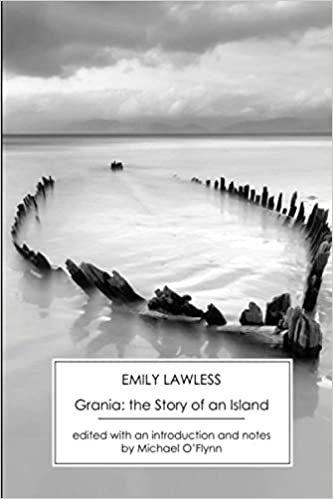
Grania: the Story of an Island by Emily Lawless
First published in 1892, Grania is a fictional story of a self-sufficient, headstrong young lass in the hard and barren barrier islands off Ireland’s mainland. She takes care of herself and her sick sister, and is benevolent to those who have less then her by providing food, despite her limited resources, to those who come to her. She is not poor like most of the others on the island, and works hard for what she has, but her kind and generous spirit demands that she share what she has.
This is a four-part story, in which part one introduces us to the protagonist – Grania, her mother and father’s backstory, and her sister’s heritage. Part two picks up six years later, where we learn of the demise of her father, her sister’s illness onset, and the growth of her love for a weak and vain man. This love relationship is a primary focus of the rest of the book, and is instrumental in Grania’s self-discovery, and we see how her sister is foundational to who she is and the choices she ultimately makes.
Grania is a chronological account of a young girl coming to maturity through the economic and weather brutalities she must face on her own. The young girl, Grania, is the protagonist, and her story begins at age 11 and is completed by 17-18 years old. She is youthful, headstrong, adventurous, strong and fearless, with a weakness for her love, Murdough Blake, whom she is smitten with.
Murdough Blake is Grania’s crush. He is lazy and lacks industry. He is self-centered, egotistical, opportunistic, and takes Grania for granted.
Honor O’Malley is Grania’s older half-sister. She is quite religious (wanted to be a nun), raised Grania, and winds up very sick. She is proud and generous, (characteristics she shares with Grania). She displays a resilience that Grania admires and emulates.
The story of Grania shines light on life in the Ireland in the late 19th century. It’s set in the factual islands of Aran. It is a rough life, where the inhabitants are cut of from the mainland half of the year, where they have to make do with circumstances of cold, extreme wet, with finite resources that often cause fatal illness in the people. Truly, what doesn’t kill you makes you stronger.
If you want to spend time in turn-of-the-century Ireland, walking in the steps of a strong young women going through emotional growth, this is a great read. I found it a bit slow going at first, but came to root for, admonish, and care about – Grania.
Why didn’t she pay more attention to science? Learning about galaxies in space or the human body is interesting, is it not? Yet, she could barely stay awake during the lectures, much less connect the whys with the whats. Now she finds falling asleep as easy as pulling a turbine through a snow storm. It’s not that turbine is working or anything, but it sure is a heavy load.
When I was young, I loved sleeping. Still do, in a sense, but now I feel like I’m wasting time if I sleep in too late or long. It’s a peaceful thing when my head hits the pillow and I have a little chat with God about the day or the things that are occupying my mind, and before you know it, I’m waking up. It doesn’t take long for me to fall asleep, but inevitably I will wake up an hour later. Rarely does this not happen. So I’ve just come to expect it. Unless my mind is unduly burdened I will usually fall asleep again fairly quickly, but if there is a big decision to be made, or a conundrum of some kind, I will toss and turn for hours. When this is the case, even conversations with God do not alleviate my insomnia.
Sometimes I think perhaps I need this time with the Lord, and I just keep talking.
We all have trouble sleeping sometimes. What do you do when you can’t fall asleep, or stay asleep? Do you get out of bed, or do you stay in bed and yearn for respite?
The Lord says we can lay our burdens on him and he will carry the weight. Sometimes I have trouble with this because I want answers right away. Just as I lay there saying go to sleep, I say I give it to you God, but then it’s still there and I know I haven’t truly given it to Him. Trusting isn’t always easy, but I know that God is watching over me and hears my pleas even if I do not see an answer immediately. He has promised, “You go before me and follow me. You place Your hand of blessing on my head” (Psalm 139:5).
Let’s trust Him, and rest easy. Til the blessed ‘morrow.
“What is gonna happen next?” she says to the silence, and she lays back falling asleep on the stroke. Day dissolves, night arises while she dreams on. The pungent smell of cool, wet night fills her nostrils, and she opens her eyes. She is looking up into the bejeweled sky, cool and dark with twinkling, blinking pinpoints of light smiling down on her. This makes her happy. She wonders which is a planet and which is a star. She cannot tell the difference. Perhaps she should have paid more attention in science.
I wondered why we are all so enamored with stars. What is it about stars? They are used to describe the pinnacle of success: we can be the star of the show, the star of the moment, the star in our field. Hollywood is full of stars – movie stars – who are often honored with a star on Hollywood Blvd. According to cartoonists, we see stars when we are dizzy. Is that because when we stare into the sky, we can feel dizzy? We speak of reaching for the stars in analogy for lofty goals. Stretching far beyond sight are the stars. Sometimes we even thank our lucky stars. They are a symbol of awesome.
Stars are awesome in the true sense of inspiring awe. Stars are something that make us feel the size of the universe, and like there is something larger than this planet that we live.
I found it curious that the Bible refers to stars quite frequently, but only a couple times to any planet and then it’s mostly talks of the moon and earth. The Lord cares even about the stars that he has created. “He counts the number of stars; He gives names to all of them” (Isaiah 147:4-4). I find that truly amazing. He knows every star that is in the universe, and they are no where near as important as we are. I think that is why we want to be stars. To know we are named, and perhaps remembered.
I have to admit, I have never been too interested in outer space, or the stars, but if God thinks they are important, I can at least appreciate them for their beauty.




 Spilling Marbles